A Simple Framework for Managing Your Closet Business
None of Us is as Smart as ALL of Us
Your Magic Numbers – $295 – 90 Minutes
Are you waking up at 3:00 AM wondering if you have enough work for next month? Do you feel like your team is either drowning in leads or "milking the clock" because the shop is empty? Does your cash flow feel like a roller coaster that you didn’t sign up to ride?
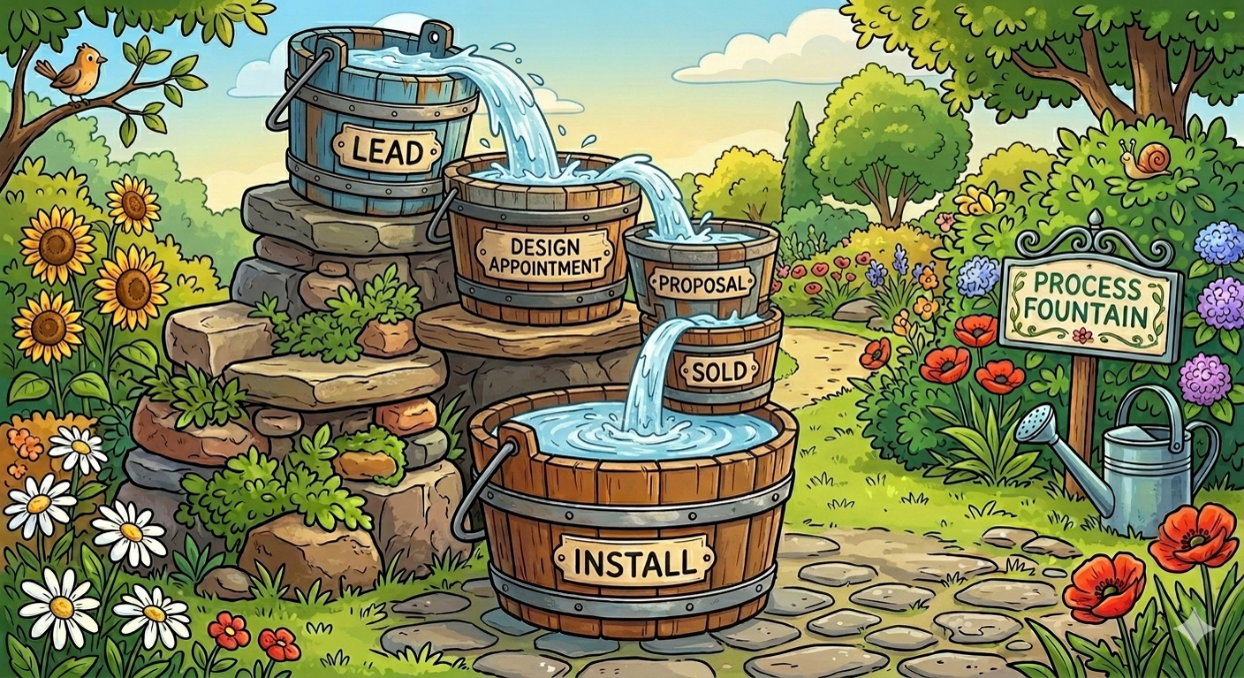
Running a closet or woodworking business is a balancing act. We know the feeling of having too many designs to draw and not enough time to breathe: or worse, having a crew ready to install with nothing on the schedule. At Coleman Collaborations Consulting Group, we believe that business management doesn't have to be a mystery. We use a simple, visual framework called "The Buckets" to help us see exactly where the pressure points are before they become emergencies.
What is a Bucket?
In our world, we visualize every customer journey as a series of buckets flowing from one to the other. If one bucket is bone-dry, the next one will be soon. If one is overflowing, the whole system gets messy.
We track five distinct stages:
- Lead (The initial contact)
- Design Appointment (The first face-to-face)
- Bid/Proposal aka The Pending Bucket (Where the follow-up happens)
- Sale/Sold (The contract is signed)
- Install (The final execution and payment)

Step 1: Getting the Team on the Same Page
Our first step is ensuring everyone: from the office staff to the installers: understands this process. When we look at our business through these buckets, we stop reacting to "the sky is falling" moments and start anticipating them.
Are your installers frustrated because they’re working 60 hours one week and 20 the next? That’s not a personnel problem; it’s a bucket problem. By tracking how much is in each stage every single week, we can see a drought coming a month away and turn on the "lead faucet" early.
Step 2: Defining "Just Right"
Every business has a "Goldilocks" number. Too many leads? Your customers wait too long for a design, and they’ll go to a competitor. Too many sales? Your install schedule pushes out three months, and your cash position gets shaky.
We need to establish what fills each bucket for our specific capacity. And this is where all 5 buckets have to be defined clearly, not vaguely.
Bucket 1: Lead
This is the top of the funnel. This bucket answers one simple question: How many leads are "just right" to feed the rest of the flow?
If our goal is a full designer calendar, and a full week for one designer is about 8-10 appointments, then we need enough incoming opportunities to consistently support that pace. Tim’s benchmark is an 80% conversion rate from Lead to Design Appointment. In plain language, that means if 10 qualified people reach out, about 8 should move to an appointment.
So we should be asking:
- Are these leads actually qualified, or are they just inquiries?
- Are we tracking phone calls, web forms, referrals, and showroom walk-ins the same way?
- Are we getting enough leads this week to support next week’s design calendar?
- If our lead count is high but our appointments are low, do we have a follow-up problem, a qualification problem, or a speed-to-contact problem?
Bucket 2: Design Appointment
This bucket is where opportunity becomes real. A full week for a designer is typically 8-10 appointments. That’s the practical capacity point we need to protect.
Using that 80% Lead-to-Appointment conversion rate, we can reverse-engineer what "just right" looks like:
- To produce 8 appointments, we need about 10 leads
- To produce 10 appointments, we need about 12-13 leads
That gives us a realistic weekly target range of roughly 10-13 quality leads to keep one designer properly fed.
And now we can ask better questions:
- Is our designer booked with the right number of appointments, or are we overloading the week?
- Are appointments spread correctly across the week, or stacked in a way that creates bottlenecks?
- Are we sending designers on low-probability calls that eat up windshield time and kill efficiency?
- If we have multiple designers, have we defined what a full week looks like for each one?
Bucket 3: Bid/Proposal
This is the pending bucket. These are proposals that are not sold yet, but they are not lost either. This is where many companies let money sit quietly and go stale.
A healthy proposal bucket requires active follow-up:
- Which bids are still open?
- How old are they?
- Has someone called, emailed, or texted the customer recently?
- Are we waiting on a decision, or have we simply gone silent?
This bucket matters because open proposals are future sales that may already be partially won. If we ignore them, we create unnecessary pressure on the Lead bucket. Before we panic and spend more money to generate new leads, we should first ask: what is already sitting in the Bid/Proposal bucket waiting to be moved?
Bucket 4: Sale/Sold
Once a job is sold, the question changes. Now we are managing pipeline and backlog.
This is not just a celebration bucket. It is a capacity bucket.
We need to know:
- How many sold jobs are in the queue?
- How many dollars are sold but not yet installed?
- Is the backlog healthy, or is it getting too far out?
- Are we selling faster than we can produce and install?
A full Sold bucket can feel exciting, but too much backlog creates stress on scheduling, purchasing, production, and customer communication. If sold jobs are stacking up too far into the future, then the business may need to slow down promotions, adjust scheduling expectations, or rethink production capacity.
The Math of a $1M Business:
Let’s look at the numbers. A $1,000,000 company generates approximately $20,000 a week in revenue (accounting for holidays and vacations).
- If we have two installers, that’s $10,000 a week each.
- Divided by 5 days, that is $2,000 a day to be completed in an 8-hour shift.
- That breaks down to $250 an hour.
Bucket 5: Install
This is where all the earlier buckets become real cash, real production, and real customer experience. The goal here is not just to stay busy. The goal is to keep installers busy for exactly 8 hours a day, not 5 hours and not 12.
That means we should be measuring install capacity with real discipline:
- Do we have enough work ready to keep each installer productive for a full 8-hour day?
- Are we scheduling jobs with the right labor hours, or are we guessing?
- Are small punch items, service calls, or missing parts breaking up the day?
- Are installers waiting on product, information, or job-site readiness?
For our $1M example, this matters a lot. If each installer is responsible for $10,000 per week, then each day needs to produce about $2,000, and each hour needs to produce about $250. That hourly number gives us a very practical reality check. If the install schedule is not built to deliver a full 8-hour day, the bucket is not truly full.

Step 3: The 8-Week Sliding Average
We don't want to make major business decisions based on one "killer" week or one "stinker" week. Instead, we use the 8-Week Sliding Average.
We simply add up the previous eight weeks of data and divide by eight. This gives us our true weekly average. This matters in every bucket: Leads, Design Appointments, Proposals, Sold jobs, and Installs. If we notice that our sliding average is moving too far in either direction, we act. This "evening out" process calms the entire company down. Our purchasing department knows the timeline, our scheduling team knows the expectations, and our installers feel safe knowing they have consistent 40-hour weeks.
Step 4: Probing Your Ratios
When the buckets aren't "just right," we have to ask the hard questions. This isn't about blaming the team; it's about diagnosing the system.
- Is the Lead Bucket low? Are we reaching out to past clients for referrals? Are we using yard signs at current installs? Are we generating enough quality leads to support 8-10 appointments next week?
- Is the Design Appointment Bucket off? Are we converting at roughly 80% from lead to appointment, or are opportunities slipping through the cracks before they ever get on the calendar?
- Is the Bid/Proposal Bucket stalled? How many open bids are sitting there right now that are neither sold nor lost? Who is following up, and how often?
- Is the Sold Bucket too full? Are we building an unhealthy backlog that pushes installs too far out and creates pressure on customer communication?
- Is the Install Bucket too full or too thin? Are we keeping installers productive for a full 8 hours a day? Have we considered a Rush Fee for clients who need it sooner? Are we communicating the lead times clearly to avoid disappointment?
Action Items to Keep Your Buckets Balanced
- Define your weekly Lead target: Work backward from designer capacity so you know how many leads are needed to support 8-10 appointments.
- Protect designer capacity: Treat 8-10 appointments as a full week and monitor whether your 80% Lead-to-Appointment conversion rate is holding.
- Audit your "Bid Bucket": Follow up with every proposal that isn't a "No" yet.
- Manage your backlog: Track sold jobs carefully so your pipeline stays healthy without pushing installs too far out.
- Set your Install target: Pick a dollar amount that is best for your business to install each week and try to hit it every single time while keeping installers productive for a full 8-hour day.
- Check your Cash Position: Ensure your customer deposits are covering your material costs immediately.
- Market Smartly: If leads are low, increase outreach and visibility before the shortage hits your install calendar.

We Are Here to Help
Managing the "meat" of the business while keeping the "casings" from breaking: much like my grandmother’s sausage machine: requires a steady hand and a clear plan. We've spent 38+ years in the closet industry learning exactly how to turn the handle "not too fast and not too slow."
Whether you need a Financial Review aka Fractional CFO service to understand your numbers, or you want to dive into Your Magic Numbers, we are ready to partner with you. You don't have to guess if your business is healthy; you can know it.
We all need someone to talk to... so let's start the conversation.
If you’re ready to stop the guessing game and start filling your buckets with intention, let's have a quick discovery call. It's a low-pressure way for us to talk through your numbers, your capacity, and your "just right."
Remember, you aren't alone in the struggle of the daily grind; we’re in this together to build a business that serves your life, not the other way around.